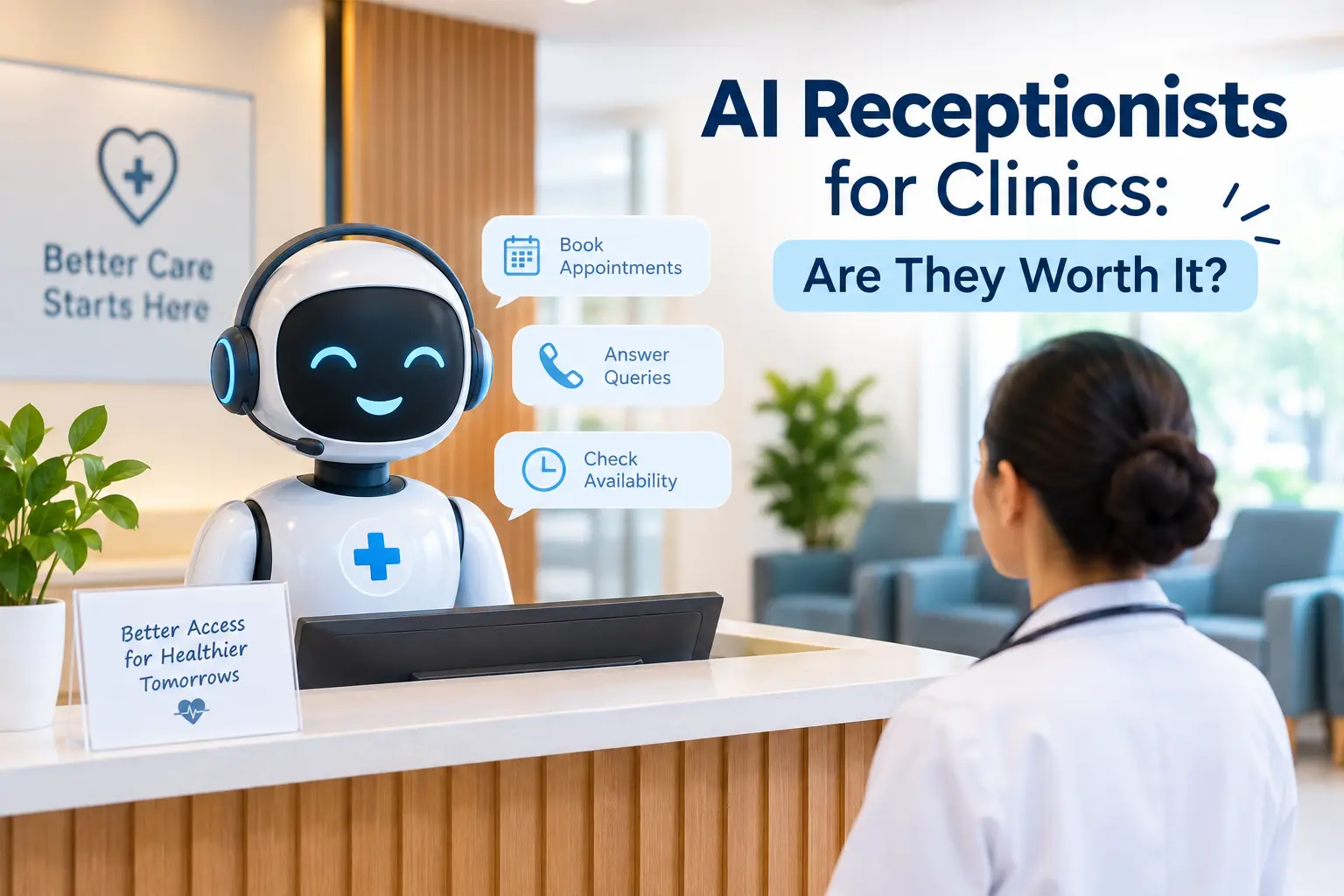
Every clinic knows the problem: the phone rings while a patient is checking in, another call goes to voicemail during lunch, and an appointment request left after hours waits until the next morning, or never gets returned. Missed calls mean missed appointments, and missed appointments mean lost revenue and frustrated patients.
AI receptionists promise to fix this by answering calls, booking appointments, and handling routine questions around the clock. But are they actually worth the investment for a clinic? This guide covers what AI receptionists do, where they help, where they fall short, and how to decide whether one is right for your practice.
What Is an AI Receptionist?
An AI receptionist is software that handles front-desk communication using artificial intelligence. Unlike older automated phone menus (“Press 1 for appointments”), modern AI receptionists use conversational AI to understand natural speech and respond in a human-like way.
Depending on the platform, an AI receptionist can work across phone calls, website chat, WhatsApp, SMS, and email. Most connect to a clinic’s scheduling or practice management software so they can check availability and book appointments in real time.
What Can an AI Receptionist Do for a Clinic?
Most AI receptionists for healthcare offer some combination of the following:
- Answer calls 24/7: Patients can reach the clinic outside working hours, during lunch breaks, and when staff are busy.
- Book, reschedule, and cancel appointments: The AI checks the calendar and confirms slots without staff involvement.
- Send appointment reminders: Automated reminders by call, SMS, or WhatsApp can help reduce no-shows.
- Answer common questions: Clinic hours, location, parking, accepted insurance, consultation fees, and preparation instructions for tests.
- Collect patient intake information: Basic details can be gathered before the visit to speed up check-in.
- Route urgent calls: Well-configured systems can recognize urgent situations and transfer the caller to staff or advise them to seek emergency care.
- Handle multiple languages: Many platforms support several languages, which is useful for clinics serving diverse communities.
- Take messages and create summaries: Calls can be logged and summarized so staff can follow up efficiently.
The Benefits of AI Receptionists for Clinics
Fewer Missed Calls
A missed call often becomes a lost patient, since many people simply call the next clinic on their list. An AI receptionist can answer every call immediately, including several at once, so no patient hears a busy tone or an endless ring.
Round-the-Clock Availability
Many patients prefer to book appointments in the evening or on weekends, when clinics are closed. An AI receptionist lets them book whenever it suits them, which improves convenience and can increase bookings.
Reduced Staff Workload
Front-desk teams spend a large share of their day on repetitive calls about timings, directions, and rescheduling. Handing these off to AI frees staff to focus on patients standing in front of them, insurance work, and tasks that need a human touch.
Lower No-Show Rates
Automated reminders and easy rescheduling make it simpler for patients to keep or change appointments rather than skipping them. For clinics where no-shows are a regular problem, this alone can make a meaningful difference.
Consistent Patient Experience
An AI receptionist doesn’t have bad days, get tired at the end of a long shift, or give different answers to the same question. Every caller gets the same accurate, polite information.
Scalability
As a clinic grows or adds locations, an AI receptionist can handle more calls without the proportional increase in hiring that a human front desk would require.
The Limitations and Risks
AI receptionists aren’t a perfect solution, and it’s important to weigh their drawbacks honestly.
They Can Feel Impersonal
Healthcare is personal. Elderly patients, anxious patients, or people dealing with difficult diagnoses may find talking to an AI frustrating or cold. Some patients will always prefer a human voice.

Misunderstandings Happen
Even advanced AI can struggle with strong accents, background noise, poor phone connections, unusual names, or complex requests. A misheard detail can lead to a wrong booking or a frustrated caller.
Not Suitable for Medical Judgment
An AI receptionist should never diagnose, give medical advice, or decide how serious a patient’s symptoms are on its own. Clinics must set clear boundaries so the AI escalates anything clinical to qualified staff, and directs emergencies to emergency services.
Data Privacy and Compliance
AI receptionists handle sensitive patient information, which brings legal obligations. Depending on where your clinic operates, this may involve regulations such as HIPAA in the United States, GDPR in Europe, or the Digital Personal Data Protection (DPDP) Act in India. Clinics need to confirm how a vendor stores, encrypts, and processes data, and whether it will sign the necessary agreements, such as a Business Associate Agreement (BAA) for HIPAA.
Integration Challenges
An AI receptionist is only as useful as its connection to your systems. If it can’t integrate with your practice management or scheduling software, staff may end up doing double entry, which defeats the purpose.
Setup and Ongoing Maintenance
AI receptionists need to be configured with accurate clinic information, scheduling rules, and escalation paths. Whenever fees, timings, or doctors’ schedules change, the system has to be updated too.
AI Receptionist vs Human Receptionist: A Quick Comparison
| Factor | AI Receptionist | Human Receptionist |
|---|---|---|
| Availability | 24/7, including holidays | Fixed working hours |
| Simultaneous calls | Many at once | One at a time |
| Cost structure | Subscription or usage-based | Salary, benefits, training |
| Empathy and judgment | Limited | Strong |
| Handling complex cases | Weak, needs escalation | Strong |
| Consistency | Very high | Varies |
| Language support | Often multilingual | Depends on staff |
| Setup effort | Configuration and integration | Hiring and training |
For most clinics, the real choice isn’t AI or humans. It’s how to combine them so each does what it’s best at.
How Much Does an AI Receptionist Cost?
Pricing varies widely by vendor, features, and call volume. Common pricing models include:
- Monthly subscriptions with a fixed number of calls or minutes included
- Usage-based pricing charged per call or per minute
- Tiered plans that unlock features such as integrations, multiple locations, or multilingual support
- One-time setup fees for configuration and integration with existing software
When comparing costs, look beyond the price tag. Factor in the value of calls currently being missed, the staff hours spent on routine calls, and the cost of no-shows. A useful approach is to estimate how many appointments you lose each month to missed calls and compare that with the monthly cost of the tool.
Is an AI Receptionist Worth It for Your Clinic?
An AI receptionist is likely to be worth it if your clinic:
- Misses a noticeable number of calls during busy hours or after closing
- Has front-desk staff overwhelmed by repetitive questions
- Struggles with frequent no-shows
- Receives many appointment requests outside working hours
- Is growing or managing multiple locations
- Serves patients who speak several languages
It may be less worthwhile if your clinic:
- Has low call volume that staff already handle comfortably
- Serves mostly elderly patients who strongly prefer human contact
- Uses scheduling software that the AI can’t integrate with
- Handles mostly complex, sensitive calls that need human judgment, such as specialized mental health or oncology practices
How to Choose the Right AI Receptionist
If you decide to try one, here’s what to look for:
- Healthcare focus: Choose a platform designed for clinics rather than a general business tool, since it will better understand medical terminology and workflows.
- Compliance and security: Ask directly about encryption, data storage location, and compliance with the regulations that apply to you.
- Integration: Confirm it works with your existing practice management, EHR, or calendar software.
- Escalation controls: Make sure you can define exactly when calls transfer to a human, especially for urgent or clinical matters.
- Voice quality and language support: Test how natural it sounds and whether it handles the languages and accents your patients use.
- Customization: Check that you can easily update clinic information, fees, and scheduling rules.
- Free trial or pilot: Test it with real calls before committing to a long contract.
- Reporting: Look for call logs, summaries, and analytics that show how the system is performing.
Best Practices for Implementing an AI Receptionist
- Start with a hybrid model: Let the AI handle after-hours calls and overflow first, then expand as you gain confidence.
- Always offer a human option: Patients should be able to reach a person easily if they ask.
- Be transparent: Let patients know they’re speaking with an AI assistant. This builds trust and is required in some places.
- Review calls regularly: Check transcripts and summaries to catch errors and refine the setup.
- Train your staff: Make sure your team knows how the AI works and how to pick up escalated calls smoothly.
- Gather patient feedback: Ask patients about their experience and adjust based on what you hear.
Frequently Asked Questions
Can an AI receptionist replace my front-desk staff?
In most clinics, it works best as a support tool rather than a full replacement. It handles routine and after-hours tasks so staff can focus on in-person care and complex requests.
Is an AI receptionist safe for patient data?
It can be, but it depends on the vendor. Always verify encryption, data storage practices, and compliance with the healthcare privacy laws that apply to your clinic before signing up.
Will patients know they’re talking to an AI?
Modern AI voices can sound very natural, but it’s good practice, and in some regions a legal requirement, to tell patients they’re speaking with an AI assistant.
Can an AI receptionist handle medical emergencies?
It should not manage emergencies. A properly configured system should recognize emergency-related language and immediately direct callers to emergency services or transfer them to staff.
How long does it take to set up?
Setup time depends on the platform and integrations. Simple setups may take a few days, while those involving complex software integrations can take a few weeks.
Does an AI receptionist work for small clinics?
Yes. Small and single-doctor clinics often benefit the most, since they usually have limited staff and are more likely to miss calls during busy periods.
Read More: The Future of AI and Automation: Trends to Watch
Conclusion
AI receptionists can be a genuinely valuable investment for clinics, especially those struggling with missed calls, overloaded staff, after-hours inquiries, or frequent no-shows. They offer 24/7 availability, consistency, and scalability that a human front desk alone can’t match.
They aren’t a replacement for human empathy and judgment, though. The clinics that get the most out of AI receptionists use them alongside their staff, with clear escalation rules, strong data protection, and a constant easy path to a real person.
The best way to answer “Is it worth it?” is to look at your own numbers: how many calls you miss, how much time your team spends on routine questions, and how many appointments go unfilled. If those numbers are significant, an AI receptionist is well worth a trial.