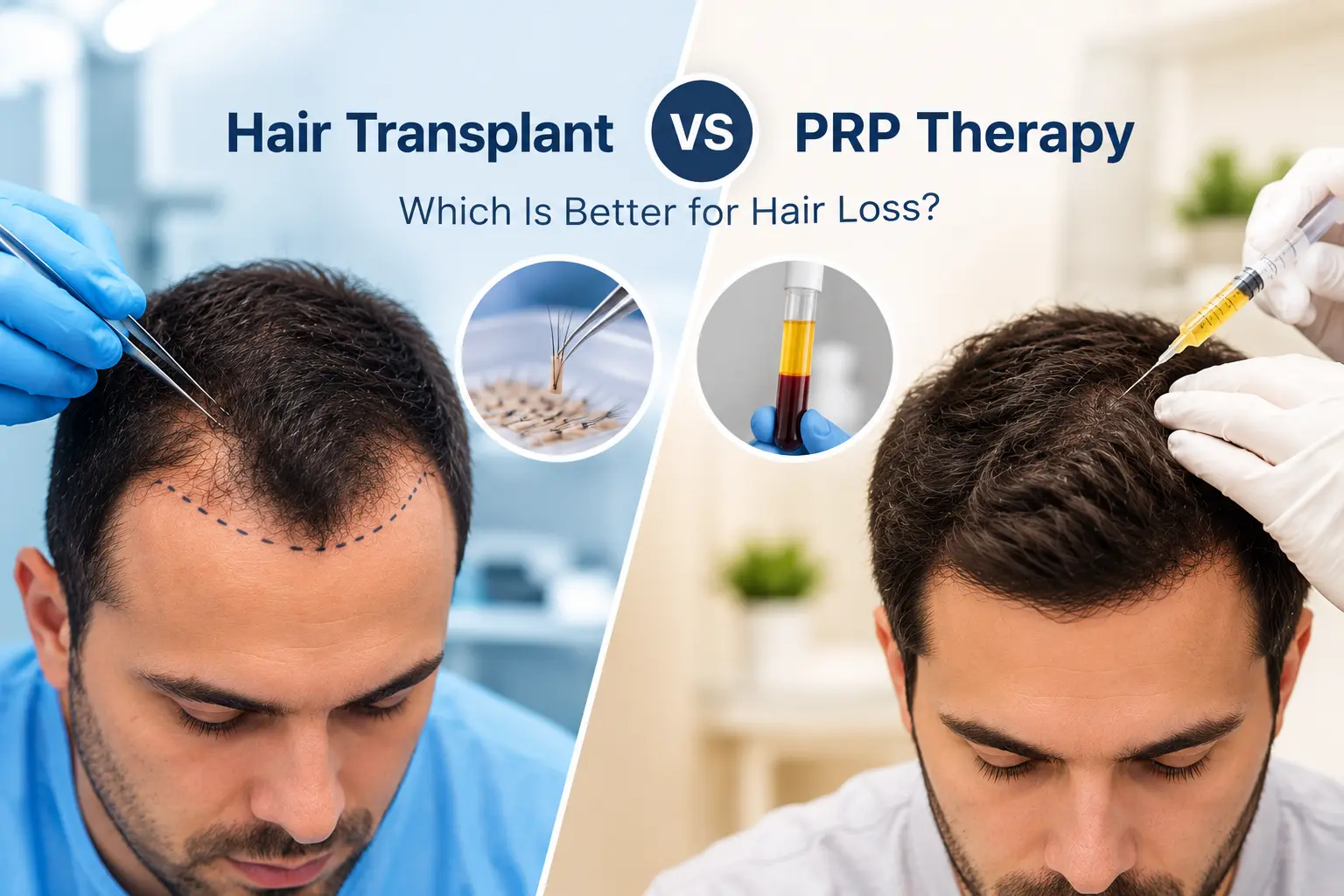
Hair loss can affect your confidence, your appearance, and even how you feel about yourself. If you’ve started researching treatments, you’ve probably come across two of the most popular options: hair transplant surgery and PRP (platelet-rich plasma) therapy.
Both treatments promise thicker, healthier hair, but they work very differently. One moves hair follicles from one part of your scalp to another, while the other uses your own blood to stimulate existing follicles. So when it comes to hair transplant vs PRP, which one is better?
The honest answer is that it depends on your type and stage of hair loss, your goals, and your budget. This guide breaks down how each treatment works, its benefits, its limitations, and who it’s best for, so you can make an informed decision.
What Is a Hair Transplant?
A hair transplant is a surgical procedure in which healthy hair follicles are taken from a “donor area,” usually the back or sides of the scalp, and implanted into thinning or bald areas. Hair in the donor area is genetically resistant to the hormone DHT, which causes pattern baldness, so transplanted hair usually continues to grow for life.
Types of Hair Transplant
There are two main techniques:
- FUE (Follicular Unit Extraction): Individual follicles are removed one by one using a tiny punch tool. It leaves small dot-like scars that are barely visible and has a faster recovery, which makes it the most popular method today.
- FUT (Follicular Unit Transplantation): A thin strip of skin is removed from the donor area, and follicles are separated under a microscope. It can yield more grafts in one session but leaves a linear scar.
Some clinics also offer DHI (Direct Hair Implantation), a variation of FUE that uses a pen-like tool to implant follicles directly.
How Long Do Hair Transplant Results Take?
Transplanted hair usually falls out within two to four weeks, which is completely normal. New growth typically begins around three to four months later, with noticeable results by six to nine months and full results at 12 to 18 months.
What Is PRP Therapy for Hair Loss?
PRP therapy is a non-surgical treatment that uses your body’s own healing factors to stimulate hair growth. A small amount of blood is drawn from your arm and spun in a centrifuge to separate the platelet-rich plasma. This concentrated plasma, which is rich in growth factors, is then injected into the scalp in areas of thinning.
The growth factors are believed to improve blood supply to hair follicles, prolong the hair growth phase, and help weak or miniaturized follicles produce thicker hair.
How Many PRP Sessions Are Needed?
A typical PRP plan includes three to four sessions spaced about four weeks apart, followed by maintenance sessions every four to six months. Most people start noticing reduced shedding and improved thickness after about three months.
Hair Transplant vs PRP: Side-by-Side Comparison
Here’s a quick look at how the two treatments compare:
| Factor | Hair Transplant | PRP Therapy |
|---|---|---|
| Type of treatment | Surgical | Non-surgical injections |
| How it works | Moves healthy follicles to bald areas | Stimulates existing follicles |
| Best for | Moderate to advanced hair loss, bald patches | Early-stage thinning, hair shedding |
| Creates new hair in bald areas | Yes | No |
| Number of sessions | Usually one (sometimes two) | 3 to 4 initial, then maintenance |
| Results timeline | 12 to 18 months for full results | Around 3 to 6 months |
| Permanence | Long-lasting, often permanent | Temporary, needs ongoing sessions |
| Recovery time | About 7 to 10 days of visible healing | Minimal, return to work the same day |
| Scarring | Small scars (FUE) or linear scar (FUT) | None |
| Upfront cost | Higher | Lower per session, adds up over time |
Benefits of a Hair Transplant
- Permanent results: Transplanted follicles are resistant to pattern baldness and typically last a lifetime.
- Restores bald areas: It’s the only treatment that can bring back hair where follicles are completely gone.
- Natural appearance: In skilled hands, a transplant can recreate a natural hairline that’s hard to tell apart from original hair.
- One-time procedure: Most people need only one or two sessions.
- Low maintenance: Transplanted hair can be washed, cut, and styled like normal hair.
Benefits of PRP Therapy
- Non-surgical: No cuts, stitches, or major downtime.
- Uses your own blood: Since PRP comes from your body, the risk of allergic reaction is very low.
- Slows hair loss: It can reduce shedding and strengthen thinning hair.
- Improves hair thickness: Many people notice fuller, denser hair after a few sessions.
- Quick sessions: Each treatment usually takes under an hour.
- Works well with other treatments: PRP can be combined with medications or used after a hair transplant.

Limitations and Side Effects
Neither treatment is perfect, so it’s important to understand the downsides.
Hair Transplant Limitations
- Requires enough donor hair: People with very thin donor areas may not be good candidates.
- Higher cost: Prices vary widely depending on the clinic, location, and number of grafts.
- Doesn’t stop future hair loss: Your non-transplanted hair can keep thinning, so you may need medication to protect it.
- Possible side effects: Swelling, temporary numbness, scabbing, itching, infection, and “shock loss” (temporary shedding of nearby hair).
- Results depend on the surgeon: A poorly done transplant can look unnatural, so choosing an experienced, qualified surgeon is critical.
PRP Therapy Limitations
- Can’t regrow hair on bald skin: PRP only works where follicles are still alive.
- Results vary: Some people respond very well, while others see little change. Research is promising, but studies differ in methods and results.
- Needs ongoing sessions: Benefits fade if you stop maintenance treatments.
- Possible side effects: Mild pain at injection sites, temporary redness, swelling, or headache.
- Not suitable for everyone: People with certain blood disorders, low platelet counts, active infections, or those on blood thinners may not be eligible.
Who Should Choose a Hair Transplant?
A hair transplant may be the better option if you:
- Have moderate to advanced pattern baldness with visible bald areas
- Have a receding hairline you want to restore
- Have stable hair loss that isn’t progressing rapidly
- Have enough healthy donor hair
- Want a long-term or permanent solution
- Are in good overall health
Doctors usually advise younger people, especially those in their early twenties, to wait, since hair loss patterns may still be changing.
Read More: Increase Your Hair Density and See the Amazing Results
Who Should Choose PRP Therapy?
PRP therapy may be the better choice if you:
- Are in the early stages of hair thinning
- Notice increased shedding but don’t have bald patches yet
- Want to avoid surgery
- Don’t have enough donor hair for a transplant
- Want to strengthen hair after a transplant
- Have certain types of non-scarring hair loss, as advised by a dermatologist
Can You Combine Hair Transplant and PRP?
Yes, and many clinics recommend it. Some doctors use PRP during or after a hair transplant to support healing and graft survival. PRP may also help maintain the surrounding native hair that the transplant doesn’t cover.
Medications such as minoxidil (for men and women) and finasteride (generally for men) are also commonly used alongside either treatment to slow ongoing hair loss. Always use these under medical guidance, as they can have side effects.
So, Which Is Better: Hair Transplant or PRP?
There’s no single winner in the hair transplant vs PRP debate, because the two treatments solve different problems:
- Choose a hair transplant if you have noticeable bald areas and want a permanent way to restore hair.
- Choose PRP therapy if you’re in the early stages of thinning and want a non-surgical way to slow loss and thicken existing hair.
- Choose both if you want to restore bald areas while also protecting and strengthening your remaining hair.
The best way to decide is to get a proper diagnosis. A dermatologist or hair restoration specialist can identify the cause of your hair loss, examine your scalp and donor area, and recommend a plan that fits your needs.
Frequently Asked Questions
Is PRP better than a hair transplant?
Not necessarily. PRP is better for early thinning, while a hair transplant is better for bald areas. They address different stages of hair loss.
Is a hair transplant permanent?
Transplanted hair is usually permanent because it comes from DHT-resistant areas. However, your existing hair may continue to thin over time.
Does PRP therapy really work for hair loss?
Many people see reduced shedding and thicker hair, but results vary from person to person. It works best for early-stage hair loss.
Is a hair transplant painful?
The procedure is done under local anesthesia, so most people feel little pain during surgery. Mild soreness and swelling afterward are common for a few days.
Can women get a hair transplant or PRP?
Yes. Women with thinning hair may benefit from PRP, and some women with stable, localized hair loss can be good candidates for a hair transplant.
Conclusion
Both hair transplant and PRP therapy are effective hair loss treatments when used for the right person at the right stage. A hair transplant offers a permanent solution for bald areas, while PRP is a gentle, non-surgical way to slow thinning and improve hair density. For many people, combining the two delivers the best results.
If you’re struggling with hair loss, don’t wait until it progresses further. Book a consultation with a qualified dermatologist or hair restoration specialist to find the treatment that’s right for you.
Disclaimer: This article is for informational purposes only and is not a substitute for professional medical advice. Consult a qualified dermatologist or hair restoration specialist before starting any treatment.