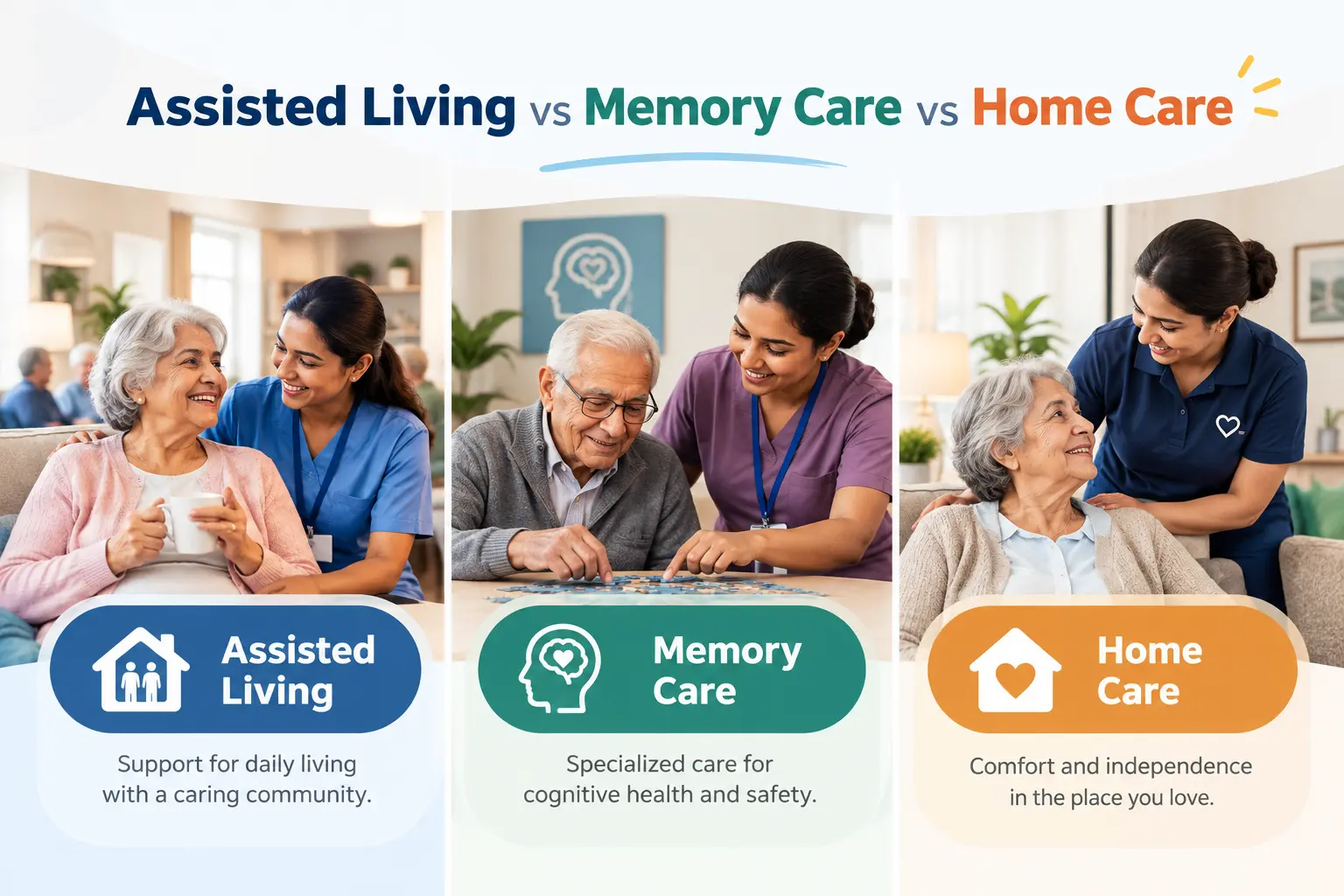
Choosing care for an aging parent or loved one is one of the most emotional and financially significant decisions a family can make. Three of the most common options are assisted living, memory care, and home care, and while they can sound similar, they differ greatly in the level of support, daily environment, and cost.
This guide breaks down what each option offers, how much each typically costs in the United States, and how to decide which one best fits your loved one’s needs and your family’s budget.
Quick Overview: What’s the Difference?
- Assisted living is a residential community for older adults who are mostly independent but need help with some daily activities like bathing, dressing, or medication management.
- Memory care is a specialized, secure form of residential care for people living with Alzheimer’s disease or other forms of dementia.
- Home care brings a caregiver into your loved one’s own home, allowing them to age in place with support for daily tasks.
What Is Assisted Living?
Assisted living communities offer private or shared apartments along with meals, housekeeping, social activities, and help with activities of daily living (ADLs). Staff are available around the clock, but residents keep a good deal of independence.
Typical services include:
- Help with bathing, dressing, grooming, and toileting
- Medication reminders or management
- Three meals a day plus snacks
- Housekeeping and laundry
- Transportation to appointments
- Social, recreational, and fitness activities
- 24-hour staff and emergency response
Best for: Older adults who can no longer live safely or comfortably alone but don’t need intensive medical care or constant supervision.
What Is Memory Care?
Memory care is designed specifically for people with Alzheimer’s disease and other forms of dementia. It can be offered in standalone communities or in a dedicated, secured wing of an assisted living facility or nursing home.
Typical services include:
- Everything offered in assisted living
- Secure environments with controlled entries and exits to prevent wandering
- Staff trained in dementia care and managing behaviors like agitation or confusion
- Higher staff-to-resident ratios
- Structured daily routines, which can reduce anxiety for people with dementia
- Therapeutic activities such as music, art, and reminiscence therapy
- Layouts designed to reduce confusion, like circular hallways and color-coded areas
Best for: People with moderate to advanced dementia who are at risk of wandering, need constant supervision, or whose behavioral needs have become difficult to manage at home or in standard assisted living.

What Is Home Care?
Home care, also called in-home care, provides support in the person’s own home. Care can range from a few hours a week to round-the-clock support.
There are two main types:
- Non-medical home care: Help with daily tasks like bathing, dressing, meal preparation, light housekeeping, errands, and companionship.
- Home health care: Skilled medical care such as wound care, injections, or physical therapy, provided by licensed nurses or therapists, usually prescribed by a doctor.
Best for: Older adults who want to stay in a familiar environment, need help with specific tasks, have family support nearby, or require care for only part of the day.
Cost Comparison: How Much Does Each Option Cost?
Costs vary widely by state, city, and level of care, but national figures give a useful starting point.
Assisted Living Costs
According to CareScout’s 2025 Cost of Care Survey, the national median monthly cost of assisted living rose 5% to $6,200, which works out to $74,400 a year. This figure is based on the reported monthly rate for a private, one-bedroom unit, so shared units may cost less and larger apartments more.
Many communities also charge extra for higher levels of care, so the base rate isn’t always the final bill.
Memory Care Costs
Memory care is almost always more expensive than assisted living because of specialized staffing, training, and security. National estimates vary by source. Estimates published in 2026 put the national average around $7,645 per month, with costs ranging from roughly $5,000 to more than $13,000 monthly. SeniorLiving.org puts the national median slightly higher, at $8,019 per month.
Families should also plan for rising costs over time. Memory care costs often increase as a resident’s condition progresses and their care needs grow.
Home Care Costs
Home care is usually billed by the hour, which means the total cost depends heavily on how many hours of care are needed. CareScout found that the national median hourly rate for non-medical caregiver services rose 3% to $35 per hour, which comes to $80,080 annually based on 44 hours of care a week.
Here’s how that hourly rate translates into monthly costs at different levels of care:
- 20 hours per week: roughly $3,000 per month
- 44 hours per week: roughly $6,670 per month
- 24/7 care: running a full 168-hour week through the national median rate comes to roughly $25,500 a month (caringvillage)
Skilled medical care at home costs significantly more. The national median hourly rate for private duty nursing is $90, with a median of $160 per visit. (genworth)
Side-by-Side Cost and Care Comparison
| Factor | Assisted Living | Memory Care | Home Care |
|---|---|---|---|
| National median cost | About $6,200/month | About $7,600–$8,000/month | $35/hour (non-medical) |
| Pricing model | Monthly fee plus care levels | Monthly fee, often all-inclusive | Hourly |
| Living environment | Residential community | Secure residential community | Own home |
| Supervision | 24/7 staff on site | 24/7 specialized supervision | Only during scheduled hours |
| Dementia-specific care | Limited | Yes, specialized | Depends on caregiver training |
| Social interaction | High | Structured, dementia-friendly | Depends on caregiver and family |
| Independence | High | Lower, safety-focused | Highest |
| Meals and housekeeping | Included | Included | Depends on hours booked |
Cost figures are U.S. national medians based on the CareScout 2025 Cost of Care Survey and 2026 memory care estimates. Actual costs vary considerably by location and provider.
Which Option Is Most Affordable?
The answer depends on how much care is needed:
- For light care needs, part-time home care is usually the most affordable option, especially when family members can fill in the gaps.
- For moderate needs, assisted living often becomes more cost-effective than home care, since the monthly fee covers housing, meals, activities, and 24-hour staff.
- For round-the-clock supervision, residential care like assisted living or memory care is typically far cheaper than 24/7 home care, which can cost several times as much.
Remember that home care costs don’t include housing expenses like mortgage or rent, utilities, food, home maintenance, and safety modifications, while residential options usually bundle many of these into one fee.
How to Pay for Senior Care
Most families pay for long-term care through a combination of sources:
- Private funds: Savings, retirement income, pensions, or proceeds from selling a home.
- Long-term care insurance: Many policies cover assisted living, memory care, and home care, depending on the terms.
- Medicare: Medicare generally does not pay for long-term custodial care such as room and board in assisted living or ongoing non-medical home care. It may cover short-term, medically necessary home health care or skilled nursing after a hospital stay.
- Medicaid: Coverage varies by state. Many states offer waiver programs that may help pay for home care or some assisted living and memory care services for people who qualify financially and medically.
- Veterans benefits: Eligible veterans and surviving spouses may qualify for VA benefits like Aid and Attendance, which can help offset care costs.
- Life insurance conversions and reverse mortgages: Some families use these tools, though they come with trade-offs and should be discussed with a financial advisor.
How to Choose the Right Option
Ask these questions to guide your decision:
1. How much help does your loved one need each day?
Occasional help with a few tasks points toward home care. Regular help with several daily activities may point toward assisted living.
2. Is there a dementia diagnosis, and how advanced is it?
Early-stage dementia can sometimes be managed at home or in assisted living. Wandering, getting lost, significant confusion, or behavioral changes usually signal a need for memory care.
3. Is your loved one safe alone?
Frequent falls, forgetting to turn off the stove, missing medications, or leaving the house unsupervised are signs that more supervision is needed.
4. How important is staying at home?
For many older adults, staying in a familiar place is deeply important. Home care can honor that preference, as long as it remains safe and affordable.
5. Is your loved one isolated or lonely?
Social isolation can harm both mental and physical health. Assisted living communities offer built-in social opportunities that home care may not.
6. What can your family realistically manage?
Family caregivers often provide significant unpaid care alongside home care. Be honest about caregiver burnout, work commitments, and distance.
7. What is your budget, now and in the future?
Consider not just current costs but how care needs, and costs, are likely to grow over time.
Signs It May Be Time to Move From One Option to Another
Care needs often change. Watch for these signs:
From home care to assisted living:
- Care needs exceed the hours you can afford
- Increasing loneliness or isolation
- Difficulty managing the home safely
- Family caregivers are becoming exhausted
From assisted living to memory care:
- Wandering or trying to leave the community
- Increasing confusion or disorientation
- Behavioral changes like agitation, aggression, or sundowning
- Assisted living staff report they can no longer meet your loved one’s needs
Tips for Touring and Comparing Providers
- Ask for a full written breakdown of fees, including base rates, care-level charges, move-in fees, and add-on services.
- Check staff-to-resident ratios, especially during nights and weekends.
- Ask about staff training, particularly dementia care training for memory care.
- Visit more than once, at different times of day, including mealtimes.
- Talk to current residents and families if possible.
- Review state inspection reports and licensing records.
- For home care agencies, ask about caregiver screening, background checks, training, and what happens if a caregiver is sick.
Frequently Asked Questions
Is memory care more expensive than assisted living?
Yes, memory care typically costs more because of specialized staff training, higher staff ratios, and secure environments.
Is home care cheaper than assisted living?
It depends on hours. Part-time home care is often cheaper, but full-time or 24/7 home care usually costs much more than assisted living.
Can someone with dementia live in assisted living?
People in the early stages of dementia can often live in assisted living. As the condition progresses, memory care is usually a safer fit.
Does Medicare pay for assisted living or memory care?
Medicare generally does not cover room and board or long-term custodial care in assisted living or memory care. Medicaid and long-term care insurance may help, depending on eligibility and the policy.
Can home care work for someone with dementia?
Yes, especially in earlier stages, if caregivers have dementia training and the home is made safe. As needs grow, round-the-clock supervision at home can become very expensive.
How do I know which option is right?
Start with a professional assessment from a doctor, geriatric care manager, or social worker. They can evaluate your loved one’s physical, cognitive, and safety needs and recommend appropriate care.
Conclusion
Assisted living, memory care, and home care each serve a different purpose. Assisted living offers independence with support and community. Memory care provides the specialized, secure environment that people with dementia need. Home care lets your loved one stay where they feel most comfortable, with costs that scale with hours.
The right choice depends on your loved one’s health, safety, cognitive condition, personal wishes, and your family’s budget. Because needs often change over time, it’s worth planning ahead and revisiting the decision regularly. Speaking with healthcare professionals, touring providers, and getting detailed cost estimates will help you make a confident, informed decision.
Disclaimer: This article is for informational purposes only and does not constitute medical, legal, or financial advice. Costs shown are national medians and estimates, and actual costs vary by location and provider. Consult qualified professionals before making care or financial decisions.