Choosing a new air conditioning system is a big decision. The right choice keeps your home comfortable for 15 years or more, while the wrong one can mean high electricity bills, uneven cooling and expensive repairs.
Two of the most popular options are ductless mini-split systems and central air conditioning. Both cool your home effectively, but they work very differently and suit different types of homes. In this guide, we compare ductless mini-split vs central AC on cost, energy efficiency, installation, comfort and maintenance so you can make the right choice.
What Is a Ductless Mini-Split System?
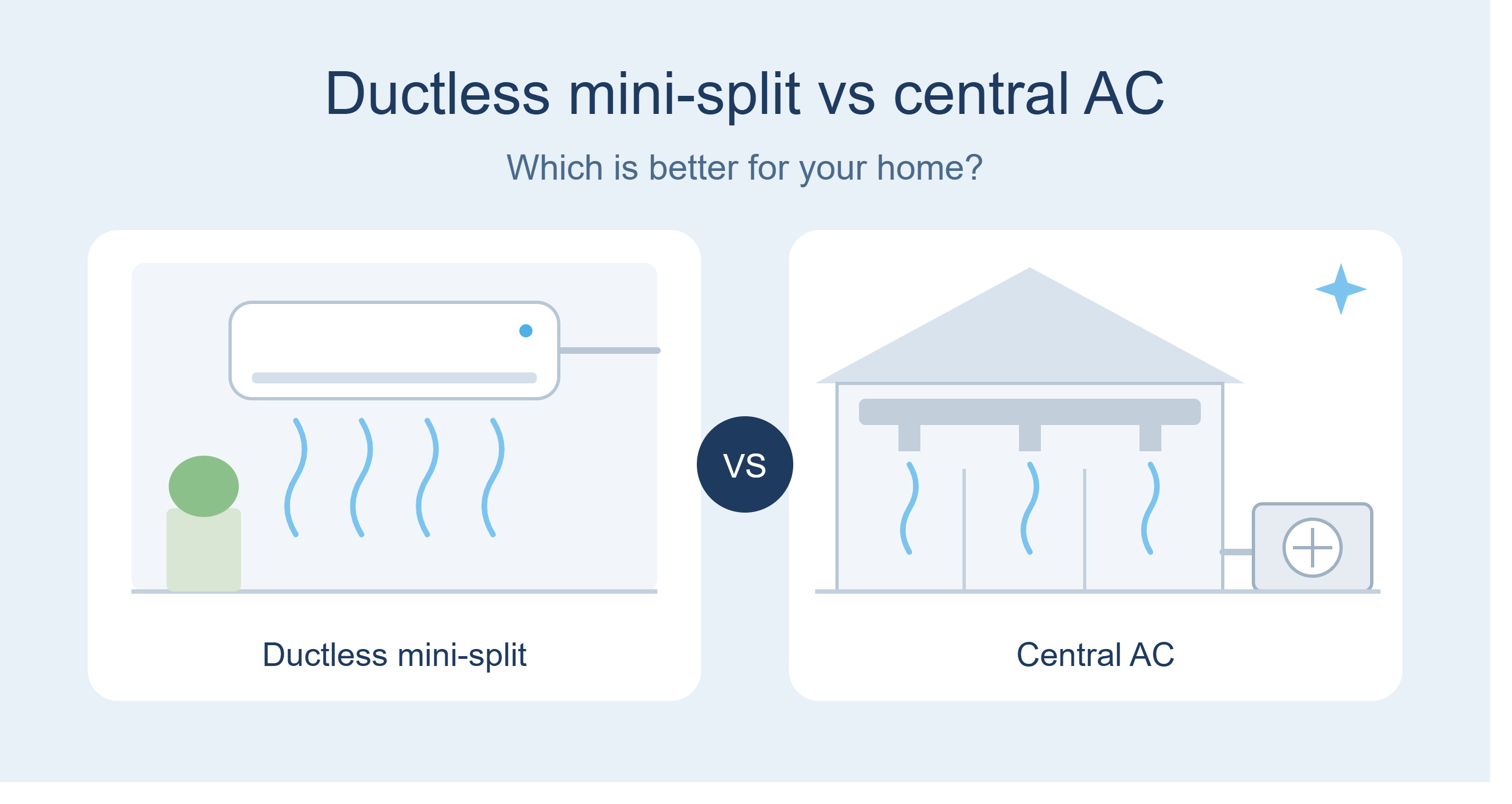
A ductless mini-split system has two main parts: an outdoor compressor unit and one or more indoor air-handling units mounted on walls or ceilings. The two are connected by a small conduit containing refrigerant lines, a power cable and a condensate drain, which passes through a hole of about 3 inches in the wall.
Each indoor unit cools the room or zone it is installed in and has its own thermostat. A single outdoor unit can usually support anywhere from one to several indoor units, which is why these are often called multi-zone systems.
Many mini-splits are also heat pumps, which means they can provide both cooling in summer and heating in winter.
What Is Central Air Conditioning?
A central AC system cools the entire home from one central point. An outdoor condenser works with an indoor coil, usually attached to a furnace or air handler, and a blower pushes cooled air through a network of ducts to vents in every room.
The whole system is controlled by a single thermostat, and it can also filter and circulate air throughout the house. Central AC is the standard choice in many larger homes, especially those that already have ductwork installed.
Cost Comparison: Ductless Mini-Split vs Central AC
Upfront Installation Cost
The cost picture depends heavily on whether your home already has ducts:
- Homes with existing ductwork: Central AC is usually the more affordable option, as you only need to replace the outdoor and indoor equipment.
- Homes without ductwork: Installing ducts from scratch is expensive and disruptive. In this case, a ductless mini-split is often cheaper and much faster to install.
- Cooling one or two rooms: A single-zone mini-split is far cheaper than installing or extending a central system.
- Cooling the whole house: A multi-zone mini-split with an indoor unit in every room can cost as much as, or more than, central AC.
Running Costs
Mini-splits generally cost less to run. They avoid duct losses, use inverter technology to adjust their speed, and allow you to cool only the rooms you are using. Over the life of the system, these savings can offset a higher upfront cost.
Factors That Affect Total Cost
- Size of your home and number of rooms or zones
- Existing ductwork and its condition
- System capacity (tonnage or BTUs) and efficiency rating
- Brand and features such as Wi-Fi control
- Local labour rates and electrical upgrades
Energy Efficiency: Which System Saves More?
When it comes to energy efficiency, ductless mini-splits usually come out ahead, for three main reasons.
1. No Duct Losses
Ducts that run through attics, crawl spaces or walls can leak, gain heat or lose cool air before it reaches the room. Energy Star estimates that a typical duct system loses 20 to 30% of the air moving through it to leaks, holes and poorly connected ducts. Mini-splits deliver cool air directly into the room, so this loss is eliminated.
[EXTERNAL LINK: Energy Star guidance on duct sealing and energy loss]
2. Inverter Technology
Most mini-splits use inverter compressors that speed up or slow down to match the cooling demand. Many traditional central AC systems simply switch on and off at full power, which uses more energy. Inverter-driven central systems do exist but typically cost more.
3. Zoned Cooling
With a mini-split, you can cool only the rooms that are occupied, such as the bedroom at night, rather than the entire house. Central AC usually cools every room at once unless you invest in a zoning system with dampers.
Efficiency Ratings
Efficiency is measured by SEER or SEER2 ratings (or star ratings in some countries). The higher the number, the more efficient the system. High-end mini-splits commonly achieve much higher SEER ratings than standard central air units, though premium central systems are narrowing the gap.

Installation: Time, Space and Disruption
Ductless Mini-Split Installation
A mini-split installation is relatively simple and minimally invasive. A professional installer mounts the indoor unit, drills a small hole through the wall, connects the lines and places the outdoor unit. A single-zone system can often be installed in a day.
This makes mini-splits ideal for:
- Older homes without ductwork
- Home additions, garages, attics and converted rooms
- Apartments and condos where ductwork is not an option
- Rooms that stay too hot even with central AC
Central AC Installation
If ducts already exist and are in good condition, a replacement central AC installation is straightforward. However, installing new ductwork can take several days to weeks and may require opening ceilings, walls or floors. Older ducts may also need sealing, repair or resizing, which adds to the cost.
Comfort, Aesthetics and Noise
Temperature Control
Mini-splits offer room-by-room temperature control, which is perfect for households where people prefer different temperatures. Central AC provides even, whole-home cooling, but some rooms, especially upper floors or rooms far from the unit, may stay warmer than others.
Appearance
Central AC is nearly invisible inside the home, with only discreet vents in walls, floors or ceilings. Mini-split indoor units are visible on walls, which some homeowners find unattractive. If appearance matters, ceiling cassette or concealed ducted mini-split units are available at a higher price.
Noise Levels
Mini-split indoor units are very quiet, often operating at a soft hum similar to a whisper. The noisy compressor sits outside. Central AC is also quiet indoors, though you may hear air rushing through vents and the blower switching on and off.
Air Quality
Central AC systems can use high-quality filters that clean the air throughout the home, and they can be paired with whole-house air purifiers and humidifiers. Mini-splits have washable filters in each indoor unit, which work well but need regular cleaning. Dirty ductwork in central systems, on the other hand, can circulate dust and allergens if not maintained.
Maintenance and Lifespan
Ductless mini-splits need their filters cleaned every few weeks to monthly, depending on use, plus an annual professional service. Each indoor unit must be maintained individually. With proper care, mini-splits typically last 15 to 20 years.
Central AC systems need filter replacements every 1 to 3 months, an annual tune-up, and periodic duct inspection and cleaning. A well-maintained central air conditioner generally lasts 12 to 17 years.
Ductless Mini-Split vs Central AC: Side-by-Side Comparison
| Factor | Ductless Mini-Split | Central AC |
|---|---|---|
| Ductwork needed | No | Yes |
| Upfront cost (no existing ducts) | Lower | Higher |
| Upfront cost (existing ducts) | Higher for whole-home | Lower |
| Energy efficiency | High (no duct losses, inverter) | Moderate to high |
| Temperature control | Room by room (zoned) | Whole house, single thermostat |
| Installation time | Usually 1–2 days | 1 day to several weeks |
| Appearance | Visible indoor units | Hidden, only vents visible |
| Heating option | Yes (heat pump models) | Needs furnace or heat pump |
| Air filtration | Individual washable filters | Central filter, whole-home |
| Lifespan | 15–20 years | 12–17 years |
| Best for | Older homes, additions, specific rooms | Larger homes with existing ducts |
Which Is Better for Your Home?
There is no single winner in the ductless mini-split vs central AC debate. The better option depends on your home and how you live.
Choose a Ductless Mini-Split If:
- Your home has no existing ductwork
- You want to cool specific rooms, an addition or a home office
- Lower electricity bills are a top priority
- Family members prefer different temperatures
- You want both heating and cooling from one system
Choose Central AC If:
- Your home already has ducts in good condition
- You want consistent whole-home cooling with one thermostat
- You prefer an invisible system with no wall-mounted units
- You want whole-house air filtration and humidity control
Consider a Hybrid Approach
Many homeowners combine both. For example, central AC can cool the main house, while a mini-split handles a hot upstairs bedroom, a garage gym or a new extension. This approach solves comfort problems without replacing the entire system.
Also Read: What Your Home’s Ceiling Design Has to Do With Heating and Cooling
FAQ
Is a ductless mini-split cheaper to run than central AC?
In most cases, yes. Mini-splits avoid the energy lost through ducts, use inverter compressors and let you cool only the rooms you use, which typically results in lower electricity bills.
Can a mini-split cool an entire house?
Yes. A multi-zone mini-split system with indoor units in several rooms can cool a whole house. However, for large homes with existing ducts, central AC may be more cost-effective.
Do mini-splits work in very hot climates?
Yes, as long as the system is correctly sized for the space. Many modern mini-splits are designed to perform well in high outdoor temperatures, so check the manufacturer’s operating range before buying.
How long does a ductless mini-split last?
With regular filter cleaning and annual servicing, a ductless mini-split typically lasts 15 to 20 years, which is often longer than a central AC system.
Can I install a mini-split myself?
Some DIY-friendly models exist, but professional installation is strongly recommended. Incorrect refrigerant handling, electrical work or sizing can reduce efficiency, void the warranty and create safety risks.
Conclusion
When comparing ductless mini-split vs central AC, the right choice depends on your home’s layout, existing ductwork and cooling needs. Mini-splits are energy-efficient, flexible and ideal for homes without ducts or for cooling specific rooms. Central AC offers seamless, whole-home comfort and is often the better value when ducts are already in place.
For the best results, have a qualified HVAC professional assess your home, calculate the right system size and recommend the most efficient solution for your budget.